Tuesday, 18 February 2014

Magnificent Mossy inspires St Vincents to All Ireland Club Championship final

St Vincents 2-14 : Ballinderry 1-13

St Vincents maestro, Tomas Quinn.
Tommy Conroy’s St Vincents travelled to Pairc Esler, county Down, last Saturday with Ulster champions, Ballinderry standing in their way of obtaining a place in this year's All Ireland Club Championship final.

Earlier that day, Castlebar Mitchels overcame the challenge of Dr Crokes to pencil in a St Patrick’s Day final in Croke Park.

Vinnie’s former Dublin star, Tomas ‘Mossy’ Quinn, was again the star man for the Dublin side. He kicked 1-08 in what was another near perfect performance for the 32 year old.

Mossy has been described as a ‘Benjamin Button’ type character by team-mate Eamon Fennell. And after seeing his display on Saturday, it’s hard to argue with that summation.

St Vincents looked comfortable throughout the game, racing into a 2-02 : 0-02 lead within the first ten minutes. Both goals involved the St Vincents playmaker.

His first goal was breathtaking. Half-back, Michael Concarr, went on a marauding run through the Ballinderry defence before passing the ball off to Quinn.

Mossy, with his back to the goal, swivelled and in one motion forcefully placed the ball into the bottom left corner of the net.

The second Vinnies goal came from full forward Ciaran Dorney. Mossy dissected the defence with a perfectly timed through-ball and Dorney coolly dispatched his shot past the despairing dive of Michael Conlon, the Ballinderry ‘keeper.

St Vincents had to organise without their inter-country star, and captain, Ger Brennan who wasn’t fit to return from minor surgery on his leg that he received just after Christmas.

Ballinderry had managed to keep Vinnies other Dublin star, Diarmuid Connolly, quiet for the first half but it was Quinn who kicked the Marino men into a 2-04 : 0-09 lead at the halftime break.

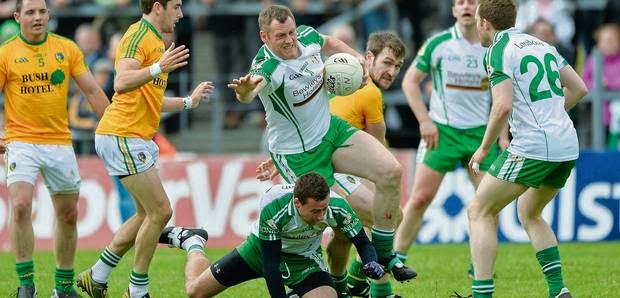
St Vincents and Ballinderry players fight for possession in the All Ireland Club Championship semi-final.
Ballinderry pulled a goal back in the second half thanks to Daniel McKinless. But with Connolly scoring three exquisitely taken points, St Vincents never looked overly nervous.

St Vincents second half lead never went under two points as the bookies favourites proved their worth.

However, it was an efficient and driven display from St Vincents in front of 4,331 spectators. When Vinnies play at their best, it is hard to see what tactical game-plan can stop them.

Mossy Quinn has been an enigma in his rejuvenation in club form since his retirement from inter-county football in 2012.

St Vincents will look to replicate the same result which saw them crowned All Ireland Club champions in 2008, with Mossy Quinn as captain.

Mossy will know he may not have many more opportunities at gaining silverware as he nears the end of a decorated career. St Vincents will want to repay the stunning displays Quinn has shown throughout their campaign this season. March 17th at GAA headquarters is sure to be an emotional day for Quinn and his Marino colleagues.

St Vincents: M. Savage; K. Bonnie, J. Curley, H. Gill; C. Diamond, B. Egan, M. Concarr; D. Murphy, E. Fennell; G. Burke (0-01), T. Diamond, S. Carthy (0-01); D. Connolly (0-03), C. Dorney (1-01), T. Quinn (1-08, 0-05 f, 0-01 '45).

Subs used: K. Golden for T. Diamond (58 mins), N. Mullins for S. Carthy (60 mins), A. Baxter for C. Dorney (61 mins).

Ballinderry: M. Conlan; G. McKinless, C. Nevin, K. McGuckin; R. Wilson (0-01), D. Lawn, R. Scott; E. Muldoon, J. Conway (0-01); C. Devlin (0-05, 0-01 f), M. McIver, D. McGuckin; D. McKinless (1-00), R. Bell (0-02), C. Gilligan (0-02, 0-01 f).

Subs used: A. Devlin (0-02) for R. Scott (15 mins), M. Harney for M. McIver (42).

Referee: Marty Duffy (Sligo) Attendance: 4,331


S.DAWSON 17/02/14

Friday, 14 February 2014

Justice for the Stardust 48

St Valentine’s Day or, simply, February 14th. It’s all a matter of opinion. However, February 14th resonates deep in the souls of many Dubliners for much more darker reasons.
“I was a Flower of the mountain yes when I put the rose in my hair like the Andalusian girls used or shall I wear a red yes and how he kissed me under the Moorish wall and I thought well as well him as another and then I asked him with my eyes to ask again yes and then he asked me would I yes to say yes my mountain flower and first I put my arms around him yes and drew him down to me so he could feel my breasts all perfume yes and his heart was going like mad and yes I said yes I will Yes.” – James Joyce.
The literary genius that is James Joyce evokes many emotions among beloved friends, family members, and intimate couples. The above extract was taken from one of Joyce’s most famous pieces, Ulysses. The romance intertwined with evocative imagery summarises what St Valentine’s Day should be about. But many Dubliners cannot come to terms with positive emotions on a day which is, traditionally, aimed at evoking love in your community.

On February 14th 1981, tragedy struck the Stardust nightclub in Artane, Dublin.

A fire took the lives of 48 revellers as they celebrated their innocent love. Over 200 more people sustained injuries from the fire that engulfed the nightclub which was packed with over 800 patrons. Officially, the exact cause of the blase is still unknown.

The remains of the inside of the Stardust nightclub after the fire which took the lives of 48 patrons.
The fire was originally noticed in the seating area of the Stardust before spreading around the nightclub, engulfing the building in unbearable smoke and flames. The burning inferno was plunged into darkness when the lighting failed. Panic spread throughout as the young attendees attempted to breakthrough fire exists which were padlocked shut. There was no emergency lighting or advice; It was hell on earth.

Yet, 35 years later, the families of the victims still seek justice.

Christy Moore, one of Ireland's greatest musicians, wrote an emotional ballad about the tragic event, entitled: 'They Never Came Home.'


The original investigation noted that arson was the cause of the fire, and the owners of the premises were handsomely compensated to the amount which would be the equivalent of €761,000 today. The families who lost relatives in the fire have not received a single cent to date.

However, thanks to relentless campaigning from the Stardust Victims Committee, Gardai agreed to launch an investigation into the previous findings. Gardai investigated the two previous inquiries, namely, The 1981 Keane Tribunal and the 2009 Coffey Tribunal. Yet many questions are still unanswered. 

The Victims Committee claim to have new evidence which shows perjury was committed in both the Keane and Coffey reviews. The committee have had fire expert, Robin Knox, working diligently alongside the families of victims as they seek answers and demand justice.

Whether or not the campaign will ultimately prove to be successful, it aims to garner enough public attention to the plight of the victim's families who, 35 years later, still mourn the tragic death of their loved ones. It is possible a cover up on behalf of previous investigations may come to light. This is the equivalent to England suffering the Hillsborough tragedy. This is Ireland’s shame. Without answers, the 48 children who attended the Stardust that night and lost their lives will have died with no explanation as to why the fire started.

On a day when love is the underlying theme of many people’s February 14th, we must appreciate the heartache, suffering, and devastation of the families of the 48 victims who never came home. 

Monday, 10 February 2014

Has Sky Sports killed the League of Ireland?


It seems that only English football can lift Irish fans spirits at present. No longer is a Dublin derby between Shelbourne and Shamrock Rovers a rivalry sufficient enough to grab people’s attention. The world has changed; society has changed with it and people’s horizons are being broadened all the time. The English Premier League, through Sky, is doing this.

The link has been broken, and a youngster’s aspiration of playing for Shamrock Rovers or Shelbourne invariably means that he won’t get to play for Ireland. If you want to represent your country, you have to go beyond the League of Ireland and play for English clubs. No longer is the League of Ireland a point to aim for: players have to seek farther and go higher and, in the process, the nails are being hammered into the coffin of the League by Sky.

Kids growing up playing football want to make it on the big stage. That big stage isn’t Tolka Park or Dalymount, it’s Anfield or Old Trafford. Every weekend we see these colossal stadia across England, packed to the rafters, illuminated with the shine of decadence and football riches. This is the lifestyle we dream of. It is no longer seen as an achievement to play at local grounds where you can almost hear what people are saying in the surrounding decrepit stands.

Sky’s coverage is second to none. This, however, affects everyone’s mindset of football in Ireland. The FAI power brokers, who run the league, are losing control of themselves. The League’s job is to manage the League and develop that League. It is to develop association football within that League. It is not to develop association football overall. The League of Ireland will never have the financial capacity to compete with the glamour and glitz of the English Premier League. It must be advertised in a different manner.

The FAI must realise that Sky is maintaining dominance of football in Ireland by broadcasting a foreign league. It is too late for blind ignorance of that fact. This has brought about the change to switch to a summer season so the league fixtures would not clash with the majority of the English Premier League matches.

This may be seen as defeatist, but it is evidential now that the English Premier League has a stranglehold on the majority of football fans in the country. The League’s continued existence is something of a miracle. There is no tangible connection between the League of Ireland and the casual football fan anymore. No matter what the League does, Sky has the money, power, and most importantly the control over the casual football fan in Ireland.  

The FAI are more concerned with securing broadcasting rights for the National team’s fixtures on Sky, rather than improving the coverage of the League of Ireland. This is a result of the influence Sky has on football broadcasting in Ireland. No matter what the League of Ireland do, they are still left out in the cold away from the warmth of the insular FAI in Abbotstown.
Daire Whelan, an Irish sports journalist comments that: “Broadcast rights to sporting events are spiralling out of control: 1992 was the year Rupert Murdoch’s Sky Sports took over the Premiership for £305 million, and within a decade broadcast rights to these games had soared to a value of £1 billion. Sports markets are following a trend set in the United States, where the rights to the NFL, NBA, and MLB, are on an upward scale in the billions, while at events such as the SuperBowl advertisers could be charged as much as $2 million for a thirty-second commercial slot.” It’s extortion.
Brian Moore, an English sports journalist, argues that point by saying that: “as Sky has no control over the administration of football, it is innocent. Strictly speaking that is true, but the effects flow from Sky's actions and they have to shoulder some responsibility, however indirectly. You cannot claim to have saved football and deny the inconvenient consequences.”
If Sky succeeds in its quest to deregulate sports broadcasting it will effectively become a monopoly broadcaster because of its financial position. The BBC cannot increase its bidding power and the failure of ITV Digital and Setanta shows that any other broadcaster would need billions of pounds to challenge Sky. Even so, it would be naive in the extreme to believe that Sky would not increase the cost of sports viewing further.

But the high cost of viewing the English Premier League on Sky rather than paying the most affordable admission fee of €15 is still preferred option of most football fans in Ireland. Sky has worked hard on presentation to satisfy the armchair supporter by including in its innovative coverage varied camera angles and intricate replay techniques that provide their audience with views that are not available to most in the stadium. For most, the choice of the English Premier League on Sky or attending a live League of Ireland match is a no-brainer.

The 'Dublin Dons' idea was not welcomed by fans of the League of Ireland.
Another aspect of how influential Sky’s coverage of football in Ireland was seen in the proposed creation of the ‘Dublin Dons’. The then Wimbledon football club owner, Sam Hamann, was looking into the possibility of relocating his team to Dublin. A proposition which was most ambitious.

The public face of the campaign in Ireland was Eamon Dunphy. Dunphy was leading the charge to bring an English football team to Dublin to play against other Premiership teams. This shows how much of an influence the English Premier League has had on the lives of Irish sports fans. However, to the defiant League of Ireland fans this was the final straw.

Without Sky and the English Premier League, League of Ireland stadia would, naturally, be overflowing with supporters. The very thought of allowing an English football team to be based in Ireland, where the home league was struggling to survive, was unfathomable.

The plans for the Dublin Dons ran as follows. The £100 million project would provide for: the building of a 50,000 all-seater stadium at Neilstown; Clondalkin, the provision of road and rail links to the stadium; the installation of all safety and security features, such as surveillance cameras, etc. Wimbledon claimed to have the backing of 18 out of the 22 League of Ireland clubs, but no evidence of this is available.
In 1997, Pat Dolan wrote in the Sunday Tribune that: “The game of football is the most popular globally, purely because it transcends social background, sex, colour, creed, age, or nationality. People, supporters, are the integral fabric of football. If advocates of this scheme put commercial gains ahead of people and supporters, what is the future for football?”
It seems, thanks to Sky, the future of football in Ireland is supporting the English Premier League and turning our back on the homely traditions of the League of Ireland. However, glamour is a perception, the reality is something different.

People in Ireland are naive about what the professional game in England entails, how hard it is to go over there and survive. That’s why a strong League of Ireland is needed. The League of Ireland is viewed by many footballers as a safety net if they do not make it in England. Therein lays the problem. Like a blanket to a child, Sky will be omnipresent in the lives of football fans in Ireland, and there is a certain soothing comfort in that. 

S.DAWSON 10/02/14

Friday, 7 February 2014

Penney finally drops for Munster

Rob Penney, current Munster head coach.
After much disconcertion within the Munster camp over Rob Penney’s tactical game-plan this season, the New Zealander will leave his role as head coach of the Irish province at the end of this season.

Penney joined Munster, along with fellow Kiwi Simon Mannix as backs coach, in 2012. He signed a two year deal with the option of a third year depending on the success of his tenure at the club.

Munster reverted from their historical reliance on their pack to bully other teams into submission and attempted to install a free-flowing passing style of play, under the leadership of Rob Penney.

Although Penney has had to bear the brunt of much criticism during his time with Munster, he has been quite successful during his two year stint.

In his first year as coach, Munster reached the semi-finals of the Heineken Cup and finished a respectable sixth in the Pro12 Celtic League.

This season Munster have further developed under the Kiwi coach. They have only lost three of their 18 matches all year and are due to play in the quarter final of the Heineken Cup against Toulouse, in Thomond Park on April 5th.

Penney will see out the rest of the season in which he hopes to see Munster achieve Heineken Cup success for the first time since 2008. However, he has confirmed that he will not sign a contract extension which would have taken him into his third year with the Province.

It is not clear why Penney has declined the contract extension, but, according to a statement released by Munster: “Rob [Penney] has attracted the interest of an unnamed club that has offered him terms that are in line with Rob’s long-term needs.”

Penney has a child currently studying at university in his native New Zealand. He has two younger children who will soon be graduating to university too. This may have been a big influence on his career move.

Penney has said that: “I am disappointed to be leaving Munster as I have thoroughly enjoyed my time here. I have to take this opportunity presented to me and prioritise my family and personal circumstances at this time.”

No announcement has been made on who will succeed Penney as head coach of Munster. However, Anthony Foley, current forwards coach with the Province, is strong favourite. The former Munster back-row forward has been hugely influential during his coaching role.

Is the time right for current forwards coach, Anthony Foley, to become head coach of Munster?
Another former Munster player, Mike Prendergast, has recently begun his coaching career in France with Grenoble. Likewise, Ronan O’Gara is in the early of stages of his coaching career with Racing Metro in France also. The opportunity of Munster head coach may have come a little too early for the former Munster stalwarts.

Unless Munster look to bring in a foreign coach once more, it looks like the job is guaranteed to be Anthony Foley’s. Given the fact Penney’s tactics were not wholly welcomed by the Munster faithful, this will benefit Limerick native, Anthony Foley, who has been associated with Munster throughout his career.

S.DAWSON 07/02/14


Friday, 31 January 2014

Racing Santander refuse to play due to unpaid wages

Racing Santander captain Mario Fernandez informs referee Gil Manzano his team will not be competing.
I’m shocked and surprised at the faux pas outrage and solidarity shown by many Irish football fans across social media in light of the actions of Racing Santander’s squad last night.

The third-tier Spanish side were due to play in their Copa del Rey quarter-final second leg fixture against Real Sociedad , last night. However, the players formed a semi-circle, arms linked in unity, at the centre circle of the pitch as soon as the referee, Gil Manzano, blew his whistle to commence the match.

The protest stems from a dispute between players and the club’s president Angel Larvin over unpaid wages. Racing Santander have fallen on hard times after two consecutive relegations, the club now faces it’s most challenging battle as they are currently in administration.

As Chris Hughton, current Norwich City manager, once said: “relegation is a fate much worse than death”. And this can be applied to the Racing Santander situation, in its most drastic form.

The squad gave forewarning of their protest at the start of the week, stating that they would refuse to play the match if president Lavin and the rest of the board didn’t resign.


A semi-final encounter against a highly acclaimed Barcelona side was on offer if they overcame their difficulties, both on and off the pitch. However, this was never a realistic option.


Racing Santander were trailing 3-1 from the first leg of the quarter-final. The second-leg was a peculiar scene in modern football awash with money. After Real Sociedad had a short spell of possession, unchallenged, the Racing Santander captain Mario Fernandez informed the officials that his side would no longer partake in the match.


The players are facing immense financial struggles. Their club captain is currently living at the clubs training ground as he cannot afford the upkeep of his house.
Racing Santander players leave the field of play.
Luis Rubiales, head of the Association of Spanish Footballers, met the Racing players and coaching staff in Santander on Thursday, and said they had the "complete backing" of his union.
It is expected that all football bodies in Spain and abroad will support the plight of the players. Although, the general outcry from armchair pundits at home in Ireland is baffling.

Complaints are coming from the same people who digest football purely provided to them by British broadcasting companies such as Sky or BT Sports. They cannot claim to have a loyalty to foreign teams in Britain.


They turn their back on the indigenous league in Ireland. They let local players suffer the same fate as these Spanish sportsmen.


Why? Because it’s much more convenient conveying dismay at the state of the game while sitting in the comfort of their home watching over-hyped and over-commercialised football from the English Premier League.


If true fans of football really want the financial woes to be eradicated, the mindset must be changed from the ground level. Support your local team. Let football thrive in your own city.


If all football fans were to adopt this lifestyle, football would return to its roots. We need to stop looking at football as a business, and return to looking at it as a sport. 
S.DAWSON 31/01/14

Monday, 16 December 2013

2013 All Ireland Senior Football Championship review

Glory for Jim Gavin's Dublin.
I remember watching Jim Gavin strut into Parnell Park for his first press conference when he was being unveiled as Dublin senior football manager at the start of the season. He looked calm, determined, and confident. It was the same humble look Gavin had when he watched the Dublin captain Stephen Cluxton lift the Sam Maguire trophy at the end of the Championship. Gavin has instilled a quietly relentless winning ethos into this Dublin panel. And it paid dividends.
                                              
Dublin were crowned both League and Championship winners this season. Dublin overcame Tyrone by a single point at the end of April to secure the Division 1 League title. And it was the same winning margin when they beat Mayo by 2-12 to 1-14 at the end of September to ensure Sam Maguire was staying in the capital. The football final wasn’t the most exciting of games but it was an All Ireland final that saw the two best teams of the summer competing. It was also a final played by two teams who endorse an expansive, skilful style of play.

This season saw Joe Brolly condemn Sean Cavanagh’s manhood after a cynical performance which has plagued Tyrone under the leadership of Mickey Harte. The GAA has had to endure a lot of negative press over widening gaps in quality between teams and over negative styles of play creeping into the game. Let’s not forget the tactics of Jim McGuinness and his Donegal team. But perhaps a new strategy is needed after Mayo dismantled his Donegal outfit by 16 points in an All Ireland quarter final. Dublin brought a breath of fresh air to the football Championship through Jim Gavin’s game plan.

Gavin inherited a talented panel of players whose foundation had been put in place by Pat Gilroy. However, Gavin blended experience with youth perfectly. Gavin worked with many of the rising stars of Dublin GAA during his tenure as under 21 manager. Paul Mannion, Jack McCaffrey, and Ciaran Kilkenny looked like seasoned veterans for Dublin throughout their campaign. Mannion and McCaffrey were both nominated for Young Player of the Year with the Clontarf man, Jack McCaffrey, collecting the accolade.

Dublin’s solid central line of Stephen Cluxton, Rory O’Carroll, Cian O’Sullivan, Michael Darragh MacAuley, Paul Flynn, and Bernard Brogan all picked up All Star awards thanks to a successful season with the Dubs. Midfielder Michael Darragh MacAuley picked up the Player of the Year award due to a outstanding season.

It was heartbreak in the final for a second year for Mayo, having lost to Donegal in 2012. It’s now 63 years since Mayo have achieved All Ireland glory. Dublin’s dominance has the potential to develop into a mini-dynasty if nurtured in the correct manner by the meticulous Jim Gavin and his coaching staff.

Aside from Dublin bossing the All Ireland, the big story of the early part of the Championship went to London GAA. Paul Coggins, London manager, managed to transform a bunch of limited footballers into a competitive side who reached the Connacht final. Their semi-final victory against Leitrim was one of the highlights of the season, winning by a single point in a 2-11 to 1-13 victory. London’s campaign highlighted the seldom positives emigration has in the world of GAA

Lorcan Mulvey evades the Leitrim defence and is the first London player to be nominated for an All Star award.

My abiding memory of the Championship this year is undoubtedly the All Ireland semi-final between Dublin and Kerry. Legendary broadcaster, Michael O’Muircheartaigh, claimed it was the best game he has witnessed since 1948. Games between these two football hotbeds have been historical landmarks in the world of the GAA.
                                                           
It seemed fitting that in a year where we lost one of the most iconic figures in the GAA, Dublin’s own Kevin Heffernan, that a match of this magnitude between these two counties occurred. ‘Heffo’ was described as having an “incalculable impact on Gaelic games” by GAA president Liam O’Neill.

Kevin McManamon scores a late goal to secure All Ireland glory for Dublin.


It was two teams playing football the way it should be played. The 3-18 to 3-11 scoreline flattered the Dubs who blitzed Kerry with a late 2-02 orchestrated by super-sub Kevin McManamon, just like in 2011. Modern greats of football all played their roles. The O’Se brothers, Maher, and Cooper for Kerry and Cluxton, Brogan, and Connolly for Dublin.

It was as good as any Dublin vs Kerry match gets. Two traditional rivals battling it out in a gripping encounter. For all the history that this fixture possesses Dublin triumphed in a match which was retro, yet absolutely modern.

S.DAWSON 16/12/13

Wednesday, 27 November 2013

2013 All Ireland Senior Hurling Championship review

Before a sliotar was pucked in this years All Ireland hurling championship, many thought it was a two horse race between Kilkenny and Tipperary. Indeed this frame of thought was further backed up when Kilkenny overcame their local rivals Tipperary in the league final by three points, on a scoreline of 2-17 to 0-20. Beaten league semi-finalists Dublin and Galway were expected to be competing with the favourites at the business end of the Championship. Subsequently, the foundations were set for another predictable year for hurling fanatics across the country.

The season unfurled with Dublin and Wexford playing out a dull draw, with the Dubs coming out on top in the replay. Next up for Anthony Daly’s men was a trip to Portlaoise to battle against Kilkenny under the leadership of Brian Cody, in his 15th year of inter-county management. Surprisingly Dublin managed to hold Kilkenny to a draw in the Leinster semi-final and a replay was due to be held the following week at the same venue.

Many thought Dublin’s chances had evaporated and Kilkenny would see off the resilient Dubs at a second chance. You just don’t get two chances to beat Kilkenny. However, Dublin succeeded in beating the Cats for the first time in 71 years by 1-16 to 0-16 in an enthralling game of hurling. Liam Rushe put in a man of the match shift in what was the greatest performance by any Dublin player I have witnessed in the blue and navy jersey.

Galway comfortably saw off the challenge of Laois to meet the Dubs in the Leinster final. Dublin’s odds were fast becoming shorter for All Ireland glory after their historic victory against Kilkenny. They overcame the challenge of Galway by 12 points securing their first Leinster title in 52 years with an emphatic victory.

Surprise results were not only found in Leinster. Just like Kilkenny toppling to lesser opposition, start of season favourites Tipperary were defeated in the Munster semi-final by a well-drilled Limerick side, on a scoreline of 1-18 to 1-15. In the quarter final of the competition Clare, under the management of the enigmatic Davy Fitzgerald in his second year as manager of his native county, overcame Waterford, Fitzgerald’s previous location in inter-county management.

Cork went on to comprehensively beat Clare in the Munster semi-final by eight points. But this was not the last time these teams would meet. In front of a partisan crowd in the Gaelic Grounds, Limerick claimed their first Munster title in 17 years after beating favourites Cork, by 0-24 to 0-15.

The qualifiers were coming to the later stages and Kilkenny and Tipperary were drawn together in an encounter many hurling purists were envisaging as a bigger match then both provincial finals. Nowlan Park was the venue and the stage was set for Henry Shefflin to make an eagerly awaited return from injury. The ‘King’ made a late cameo appearance and was greeted with a chilling roar as he entered the field of play to help the Cats see out a three point victory.

The atmosphere of a Kilkenny vs Tipperary match is something all Irish sports fans must experience at least once in their lifetime. It’s often difficult for those of us living in the metropolis of Dublin to understand the colloquial rivalries of these two hurling strongholds. Even chatting to Kilkenny fans as I left O’Moore Park in Portlaoise after a Dublin victory, they weren’t overly disenchanted. Why? Because they had a crack at the Premier county, Tipperary.

In the other qualifiers Waterford and Clare were quietly and efficiently seeing off the respective challenges of Westmeath and Laois. A Wexford side, which brought Dublin to a replay in the early stages of Leinster, saw off a poor Carlow team before being comprehensively beaten by Clare by ten points in stage three of the qualifiers. Clare showed no remorse in extra time stepping up a gear to see off the challenge of Wexford.

With Tipperary bowing out in the earlier qualifying round and Kilkenny not at their expected best, some savvy punters were keeping a close eye on Davy Fitzgerald’s young Clare team. The Clare vs Wexford game preceded another gripping encounter which needed extra time to separate the teams. An ageing Kilkenny side saw off a plucky Waterford team by three points on a scoreline of 1-22 to 2-16.

An extremely exciting hurling championship came to its quarter final stage in the last weekend of July. It was Cork vs Kilkenny and Galway vs Clare in a double header played out in what many perceive to be the home of hurling, Semple Stadium in Thurles. Cork saw off the challenge of Kilkenny by five points. Henry Shefflin saw red in what was a very harsh decision in the eyes of many neutrals. There was an eerie atmosphere that this result signalled an end of an era for Kilkenny hurling.

Although a plethora of injuries in 2013 didn’t help the cause, it would be an almighty shame if Shefflin was to bow out of inter-county hurling in such circumstances. However, Cody was ratified as Kilkenny manager for their 2014 campaign. Only time will tell if Cody can bring future success to a team who know they underperformed this season.

Clare continued their winning streak by beating Galway 1-23 to 2-14. Many questioned Davy Fitzgerald’s tactical nous coming into the hurling championship but critics were silenced when Clare employed a sweeper system which quelled the attacking threat of Joe Canning for Galway. The hurling championship which kept churning out epic encounters had Dublin vs Cork and Limerick vs Clare as the semi-final fixtures, as these underdog counties came to the fore at the end of the hurling campaign.

Dublin and Cork played out one of the games of the year which the Rebels won by 1-24 to 1-19. The scoreline certainly doesn’t reflect how close the game was. The sides were level an astonishing 15 times throughout the 70 minutes. Ryan O’Dwyer’s sending off and a goal scored by Pat Horgan, who had a red card rescinded so he could partake in the match, proved to be the pivotal moments of the game. Many were tipping Dublin for an All Ireland double in both codes of the game, but Cork’s victory now made them strong favourites for All Ireland hurling glory.

In the other semi-final Clare beat Munster champions Limerick, 1-22 to 0-18. It was undeniable that Davy Fitzgerald was doing a magnificent job in transporting the success of a young under 21 Clare team into a promising senior side who could put it up to any side on their day. Davy Fitzgerald had managed to bring this Clare side to an All Ireland final in only his second year of managing them. The Banner county were on the precipice of claiming their fourth All Ireland title. All that stood in the way was Cork.

Clare and Cork already met on three separate occasions throughout the year. Clare got the better of their Munster neighbours both times during their league campaign, including a high scoring relegation play-off in the Gaelic Grounds. Clare were victorious on a scoreline of 0-31 to 2-23. However, almost three months later in the same venue Cork won by eight points in the Championship. There wasn’t much between these two teams as they faced into their September showdown, after being ranked as outsiders at the beginning of the All Ireland Championship.

The All Ireland final would eventually go to a replay thanks to a late point from young corner back, Domhnall O’Donovan, with the last puck of the game. Cork must have seen this as a missed opportunity in a match which was far from a classic. What unfolded in the replay could not have been scripted. An enthralling game from start to finish. A late call up to the starting 15 was young corner forward Shane O’Donnell, who put in the individual performance of the year with his early hat-trick.  

Clare defend their goalmouth in large numbers in the All Ireland final
Both teams started the game with such ferocity, one would think the game would have a lull. It didn’t. Cork showed great fight in coming back from an eight point deficit in the first half but late goals from Conor McGrath and Darach Honan sealed a famous victory for the Banner county. Clare eventually came out on top by 5-16 to 3-16. Davy Fitzgerald had constantly referred to his Clare side as the “little fish” and it was his school of young hurlers who brought the Liam McCarthy cup home to Clare.

It was no surprise that Clare dominated the All Star team with eight representatives. Tony Kelly also made history in becoming the first hurler to receive the Young Hurler of the Year award and Hurler of the Year award in the same season. Credit must be given to Jimmy Barry Murphy for bringing an unfancied Cork so far in the Championship. It was a refreshing year for hurling with the big two of Kilkenny and Tipperary bowing out before the semi-final stage.

This young Clare side will be the ones to beat next year as they look to retain their title. A resurgent Dublin and a Kilkenny side who will still be feeling the pain of defeat, will be chomping at the bit to topple Davy Fitzgerald’s men in what is sure to be another frantic and entertaining All Ireland hurling Championship.  

S.DAWSON 27/11/13